This page has been idle for a while. To make sure you don't miss out on the latest content, please reload the page.Refresh
Refresh
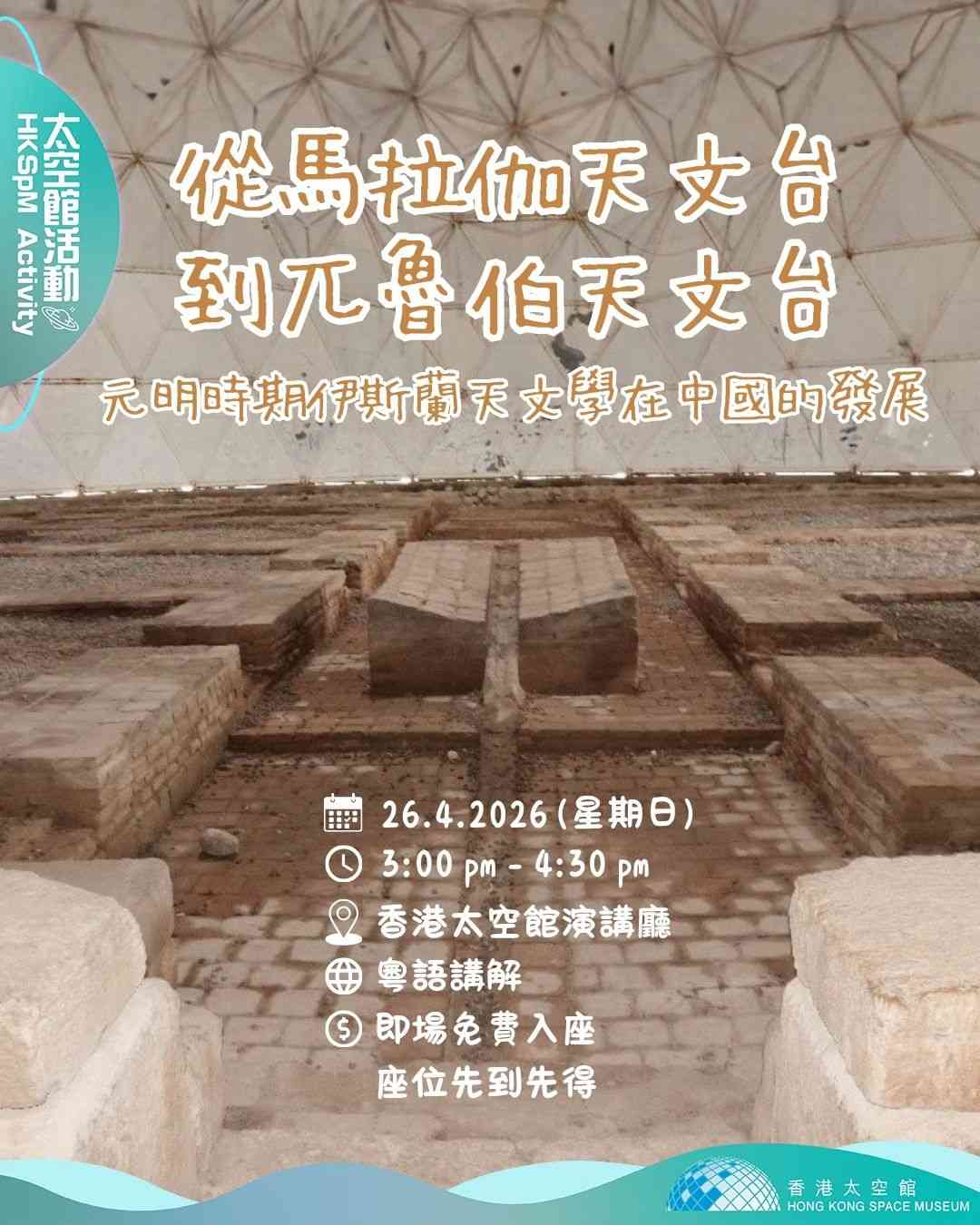
In the 13th century, the Maragha Observatory in present-day West Asia boasted a gigantic stone astronomical instrument, the 'Wall Quadrant', as well as a precise Islamic mechanical water clock. The director of the observatory, Nasir al-Din al-Tusi, invited a Chinese Taoist scholar named Fu Ye to assist in compiling an astronomical calendar.
In the 15th century, the ruler of the Timurid Empire (located in present-day Uzbekistan), Ulugh Beg, constructed another magnificent observatory, the Ulugh Beg Observatory, in the ancient Central Asian city of Samarkand. This observatory featured a stone instrument called a 'sextant'. Over a short span of 15 years, he sent envoys to the Ming Dynasty in China six times, engaging in frequent cultural exchanges.
From the Maragha Observatory to the Ulugh Beg Observatory, this lecture will take you on a journey through time and space, delving into the story of the development of Islamic astronomy in China during the Yuan and Ming periods.
Speaker: Prof. Fung Kam-wing (Dean of the Faculty of Arts and Social Sciences, Chu Hai College of Higher Education; Zhikezhen Professor of Science History, Chinese Academy of Sciences)
Language: Cantonese
No reservation is required. Admission is free and available on a first-come, first-served basis. This lecture will be held onsite and will not be live-streamed. The event is co-organized by the Hong Kong Space Museum and the Ptolemy Museum.






























![Kai Tak Stadium | [25+ Emperor Entertainment Group All-Star Concert] Total investment exceeding 100 million RMB; Top stars and award-winning actors perform; A phenomenal show at Kai Tak Main Stadium; A golden team crafts a stage with intricate mechanisms](https://img.etnet.com.hk/customcover/event/2026/02/25/Emperorgpcon-2026-1_m.jpg)




![Mong Kok Macpherson Stadium | Popular male star Lee Je-hoon celebrates his 20th anniversary in the industry on April 30, Macpherson Stadium [Our 20th Moment 2026 LEE JE HOON FANMEETING]](https://img.etnet.com.hk/customcover/event/2026/03/10/LEEJEHOONFANMEETING-2026-1_m.jpg)